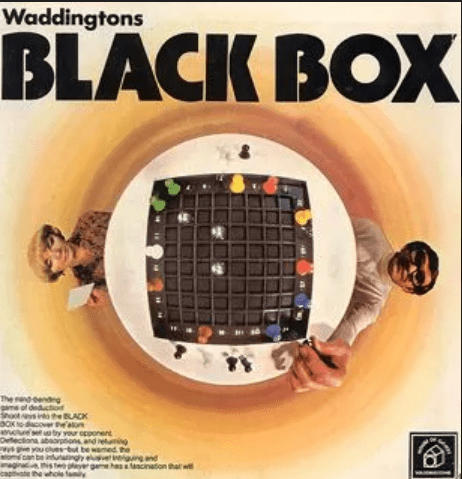
There is a particular quiet that settles over me when I play Black Box, the same hush I feel doing a crossword in a sunny window with a cat asleep on the table. No theme, no chatter, no luck, just me, a grid, and a few hidden atoms I have to find with nothing but logic and patience. It is one of the oldest pure deduction games around, and still one of the most quietly satisfying things I own.
Your opponent secretly places a handful of atoms on a square grid, hidden from you. You probe by firing imaginary rays into the edges, and from where each ray emerges, or whether it vanishes entirely, you deduce what it must have struck. A ray that hits an atom head on is absorbed, a ray that passes near one is deflected, and the patterns of hits and bounces slowly betray where the atoms hide. Guess their positions in as few rays as possible to win.
The joy is the slow click of certainty. Each ray is a question, and a clever sequence of them narrows the possibilities until the hidden layout snaps into focus in your mind, all at once, like a held breath let go. It feels like the deduction half of Battleship grown up and refined into something genuinely brainy.
It plays head to head or even solo with a puzzle setup, teaches quickly, and packs a great deal of thinking into a tiny footprint. There is no luck at all here, only the pleasure of reasoning your way to the answer. For fans of logic puzzles and pure deduction, it is an elegant, timeless little gem.
Are you a fire lots of rays prober or a deduce with as few as possible minimalist? Tell me below, and tell me the layout that fooled you completely.
 GameShoutOut