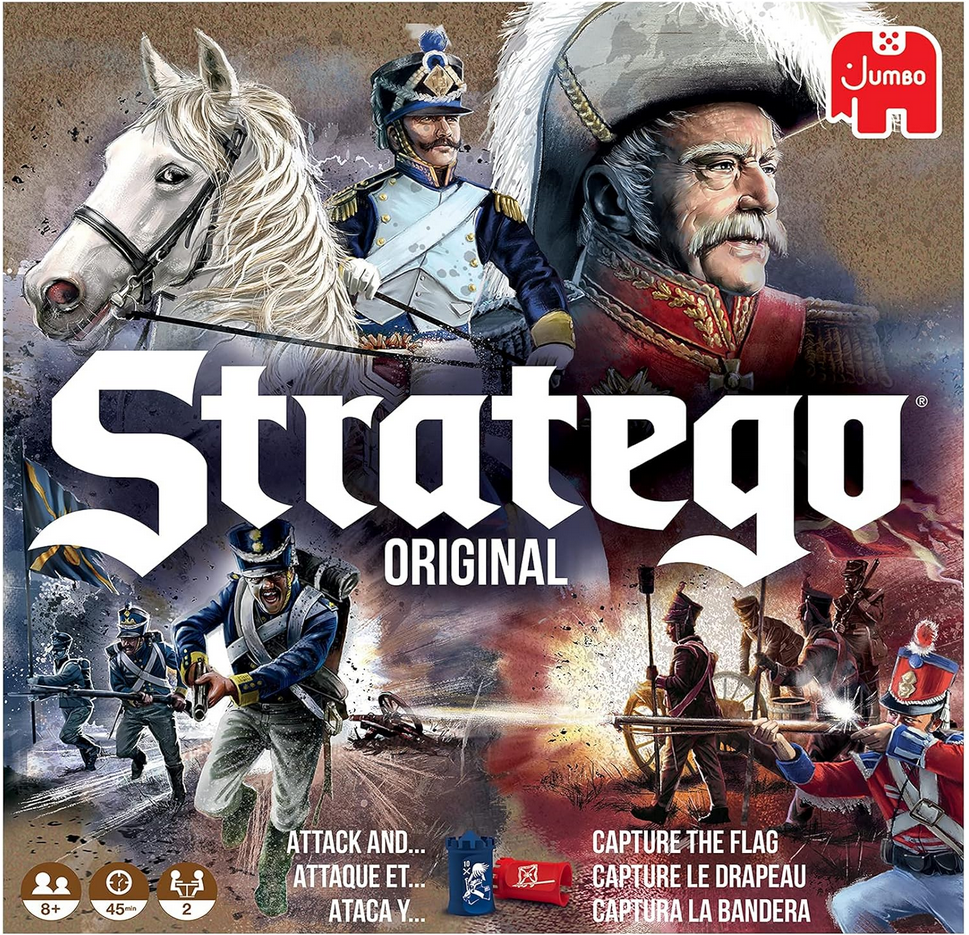
The first time I marched a lone little Scout across the board on an obvious suicide run, my opponent assumed it was a desperate blunder. It was not. It was a question, and the answer, a flipped tile revealing their Marshal, cost me one Scout and won me the next twenty minutes. Stratego taught me young that the strongest piece on the board is the one your opponent only thinks you have.
You each command forty pieces, lined up with their ranks turned secretly toward you. You see your own Marshals and Generals and lowly Scouts; your opponent’s army is a silent wall of blank backs. You advance, probe, attack, and only when two pieces collide do you learn who outranks whom, the higher number capturing the lower. The goal is gloriously simple: punch a hole in the line and seize the enemy flag.
The whole game lives in the not knowing. Is that piece striding boldly forward the enemy Marshal, or a humble Sergeant bluffing for its life? Are those motionless pieces guarding the flag, or just Bombs daring you to waste a Miner? You learn to read hesitation, to lay traps, to spend a Scout purely to reveal something. And there is always the Spy, the weakest piece on the board, who can topple the mighty Marshal stone dead if it strikes first.
It is a slow, simmering duel of nerve and memory, rewarding patience, misdirection, and the occasional outrageous lie. Decades on, I still get the same little jolt of glee flipping over a captured piece and discovering I just felled a giant.
Are you a cautious line holder or a reckless Scout rushing gambler? Tell me below, and tell me about the bluff that won, or catastrophically lost, you the whole war.
Please consider using our affiliate link if you decide to purchase this title: https://amzn.to/4aqX7lM
 GameShoutOut